On or near this date, Lewis and the Mandan delegates leave Fincastle and cross the James River at Looney’s Ferry, present Buchanan, Virginia. The Great Wagon Road they are following to Washington City soon after crosses the Cedar Creek chasm on the Natural Bridge—a spectacular stone arch on property owned by Thomas Jefferson.
Buchanan, Virginia
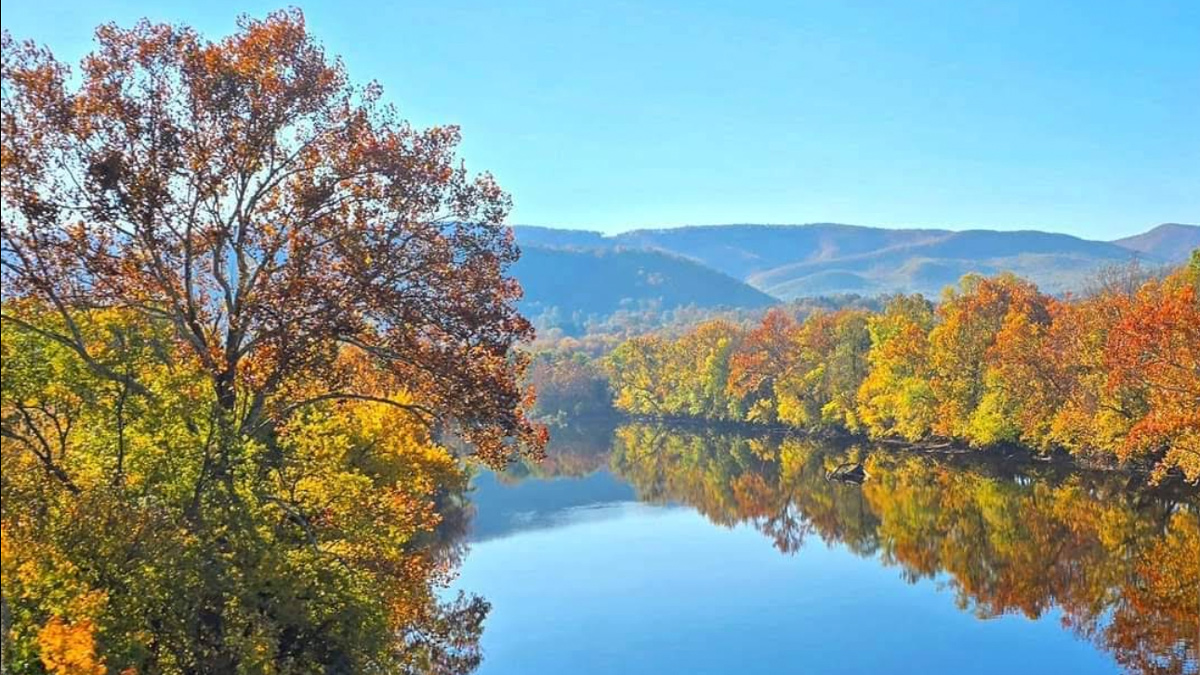
Historically, the James River connected Virginia’s Tidewater, Piedmont, and Mountain and Valley regions. Starting around 1745, travelers on the Great Wagon Road could cross the river at Looney’s Ferry near present Buchanan, Virginia. Early settler Robert Looney established his mill and ferry there, and after his death in 1755, his heirs established the towns of Pattonsburg and Buchanan on each side of the crossing. In 1806, Lewis would have found taverns and ordinaries, merchant stores, and a post office. The two towns merged as Buchanan in 1882.[1]“Buchanan Historic District”, Virgina Department of Historic Resources, www.dhr.virginia.gov/historic-registers/180-0028/, accessed 12 October 2026; “Buchanan Historic … Continue reading
Natural Bridge
The Natural Bridge, Virginia (1852)
Frederic Edwin Church (1826–1900)
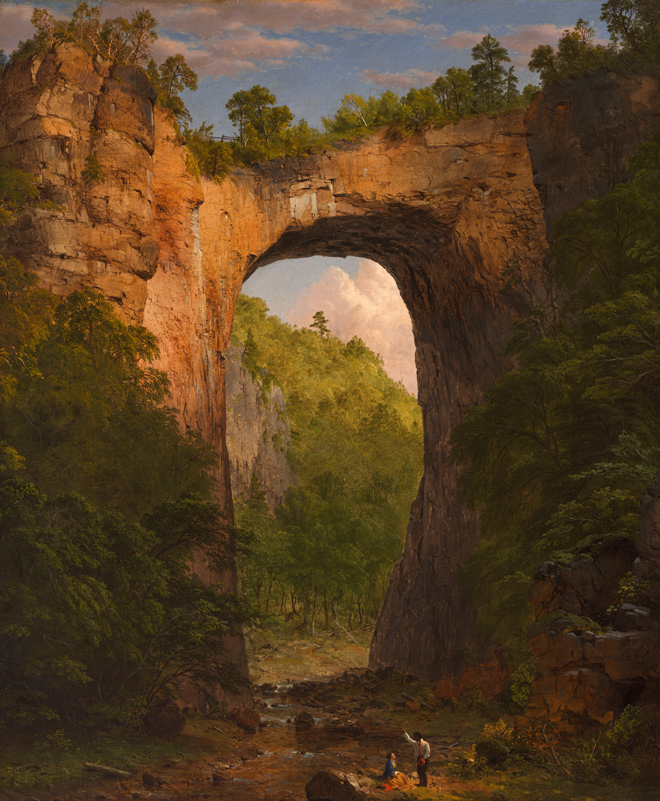
Courtesy Fralin Museum of Art, gift of Thomas Fortune Ryan, 1912.1.
In June 1805, Lewis paused at the Big Fall of the Missouri River and wrote a detailed, 900-word, yet “imperfect description”:
I wished for the pencil of Salvator Rosa, or the pen of Thompson, that I might be enabled to give to the enlightened world some just idea of this truly magnifficent and sublimely grand object . . . .
—Meriwether Lewis, 13 June 1805
Many years earlier—likely August 1767—Lewis’s mentor Thomas Jefferson first saw another “sublime” object—Virginia’s Natural Bridge. About the natural wonder, Jefferson wrote the following:
The “Natural bridge”, the most sublime of Nature’s works, though not comprehended under the present head, must not be pretermitted.
. . . [F]ew men have resolution to walk to them and look over into the abyss. You involuntarily fall on your hands and feet, creep to the parapet and peep over it. Looking down from this height about a minute, gave me a violent head ach. This painful sensation is relieved by a short, but pleasing view of the Blue ridge along the fissure downwards, and upwards by that of the Short hills, which, with the Purgatory mountain is a divergence from the North ridge; and, descending then to the valley below, the sensation becomes delightful in the extreme. It is impossible for the emotions, arising from the sublime, to be felt beyond what they are here: so beautiful an arch, so elevated, so light, and springing, as it were, up to heaven, the rapture of the Spectator is really indiscribable![2]Thomas Jefferson, Notes on the State of Virginia, William Peden, ed. (Chapel Hill: University of North Carolina Press, 1955), 24–25, archive.org/details/thomasjeffersons0000will/; as corrected from … Continue reading
In 1774, Jefferson would come to own 157 acres containing Natural Bridge and for several decades thereafter, he encouraged visitors to come to the site. The Great Wagon Road was built atop the bridge, so one can only wonder if Lewis and the Mandan delegates—consisting of Sheheke, his wife Yellow Corn, and their son, as well as the wife and two children of interpreter René René Jusseaume—stopped to marvel at the view of the mountains or peer over its edge.[3]“Natural Bridge”, National Register of Historic Places registration form (Rockbridge County, Virginia), … Continue reading
Seeking the Spanish Trace
We again dispatched parties in search of the trace . . . . [The] Spanish troops had ascended a dry valley to the right—on their return they found some rock salt, sample of which were brought to me. We determined to march the morrow to the entrance of the valley; there to examine the salt, and the road.
—Zebulon M. Pike[4]Donald Jackson, The Journals of Zebulon Montgomery Pike (Norman, Oklahoma: University of Oklahoma Press, 1966), 1:355–56.
Here, Pike became disoriented. He had come to a situation similar to that of Lewis and Clark at the Three Forks of the Missouri except that Pike made the wrong choice as to which fork to take. When backtracking, he returned to the Arkansas River but thought it was the Red. That error would lead him into the Spanish Territory where he was taken prisoner.
Also related: Searching for Salines
Notes
| ↑1 | “Buchanan Historic District”, Virgina Department of Historic Resources, www.dhr.virginia.gov/historic-registers/180-0028/, accessed 12 October 2026; “Buchanan Historic District”, National Register of Historic Places registration form (Botetourt County, Virginia), www.dhr.virginia.gov/wp-content/uploads/2019/02/180-0028_Buchanan_HD_1999_Final_Nomination.pdf. |
|---|---|
| ↑2 | Thomas Jefferson, Notes on the State of Virginia, William Peden, ed. (Chapel Hill: University of North Carolina Press, 1955), 24–25, archive.org/details/thomasjeffersons0000will/; as corrected from Jefferson’s notes on the first edition. |
| ↑3 | “Natural Bridge”, National Register of Historic Places registration form (Rockbridge County, Virginia), www.dhr.virginia.gov/wp-content/uploads/2018/04/081-0415_Natural_Bridge_1997_Final_NRHP_Nomination-1.pdf. |
| ↑4 | Donald Jackson, The Journals of Zebulon Montgomery Pike (Norman, Oklahoma: University of Oklahoma Press, 1966), 1:355–56. |
Experience the Lewis and Clark Trail
The Lewis and Clark Trail Experience—our sister site at lewisandclark.travel—connects the world to people and places on the Lewis and Clark Trail.
Discover More
- The Lewis and Clark Expedition: Day by Day by Gary E. Moulton (University of Nebraska Press, 2018). The story in prose, 14 May 1804–23 September 1806.
- The Lewis and Clark Journals: An American Epic of Discovery (abridged) by Gary E. Moulton (University of Nebraska Press, 2003). Selected journal excerpts, 14 May 1804–23 September 1806.
- The Lewis and Clark Journals. by Gary E. Moulton (University of Nebraska Press, 1983–2001). The complete story in 13 volumes.
This site is provided as a public service by the

Lewis and Clark Trail Alliance
with additional funding from the following: