On or near this date, Lewis and the Mandan delegates pass through Lexington along Virginia’s Great Wagon Road. There, they saw several brick buildings—many of which are still standing today.[1]Traveling with Meriwether Lewis to Washington City is a Mandan delegation from the Knife River Villages—Chief Sheheke, his wife Yellow Corn, and their son. Speaking Mandan and French was … Continue reading
From Washington City, President Thomas Jefferson assures Caspar Wistar that Lewis is headed to the city and that an engraved map of the expedition’s route will be sent to the American Philosophical Society in Philadelphia.
Lexington, Virginia
Lewis and the Mandan delegates could have seen the ruins of Liberty Hall as they passed through Lexington. They could also see the university’s new building which was in place by 1805. Downtown at the corner of Washington and Main, stood the Alexander-Withrow House, built by 1790 for William Alexander to serve as his store and residence. In 1806, the house had 2 stories, a gabled roof, and a chimney at each of the four corners—a common Rockbridge County style. Today, the Alexander-Withrow house still stands although when Lexington’s streets were lowered, a new first floor was added with large shop windows—currently an upscale restaurant.[2]“Alexander-Withrow House”, Virgina Department of Historic Resources (2 June 2023), www.dhr.virginia.gov/historic-registers/117-0001/; “Lexington Historic District”, National … Continue reading
Alexander-Withrow House
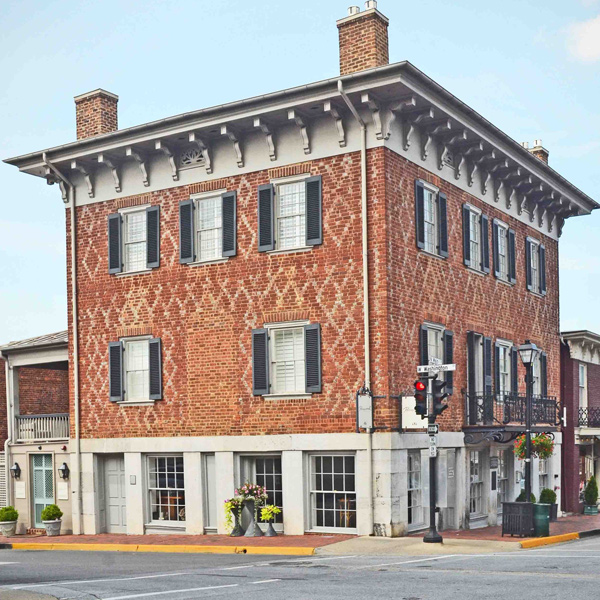
Calder Loth, 2018, The Virginia Department of Historic Resources.
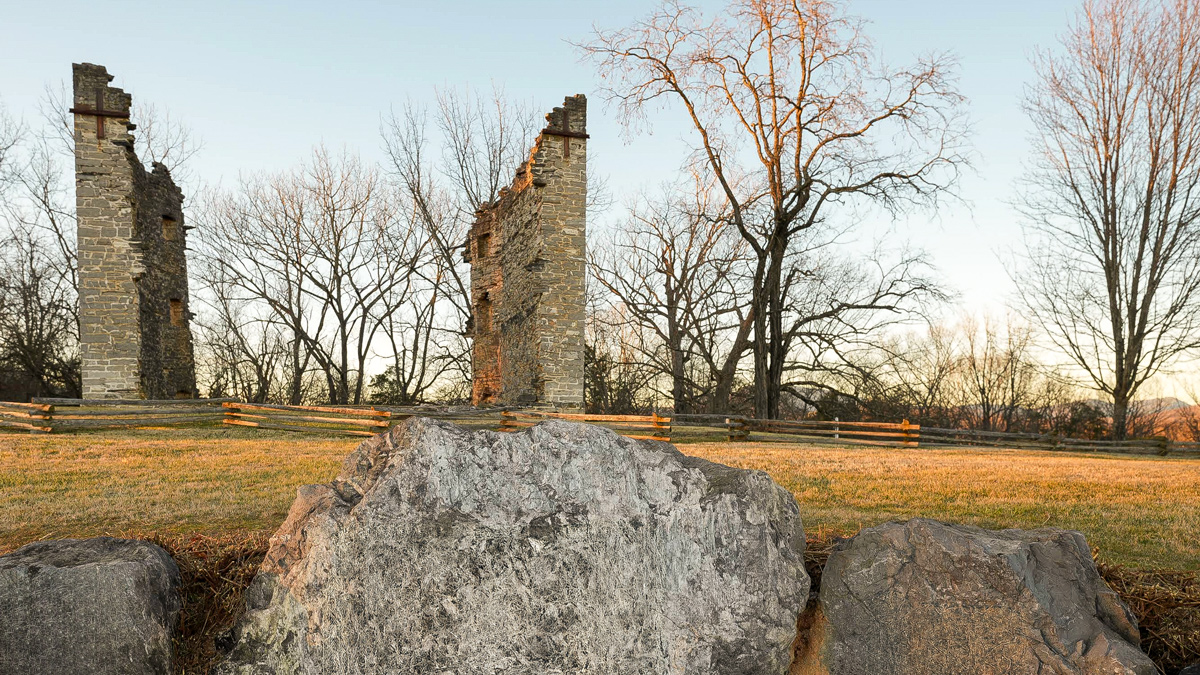
A marker at the ruins reads:
Liberty Hall Academy — 1782 – 1803
Washington and Lee University traces its origins to Augusta Academy, a small classical school established in 1749 by Scotch-Irish pioneers some twenty miles north of Lexington. In 1776, the patriotic fervor of the American Revolution caused Augusta Academy Trustees to change its name to Liberty Hall. In 1782, the same year that the school relocated at this site, the Virginia legislature chartered the institution as Liberty Hall Academy and granted it the authority to confer degrees upon its graduates. After two wooden academic buildings burned, the stone building depicted above was constructed in 1793. After George Washington bestowed a major benefaction upon the school in 1796, grateful Trustees changed the name to Washington Academy. In 1803, the academy again fell victim to the ravages of a fire that left standing only the wall that remain on the site. In the fire’s aftermath, the school relocated at its present site in Lexington and in 1813 became Washington College. In 1870, upon the death of its president Robert E. Lee, its name was changed a final time to Washington and Lee University.
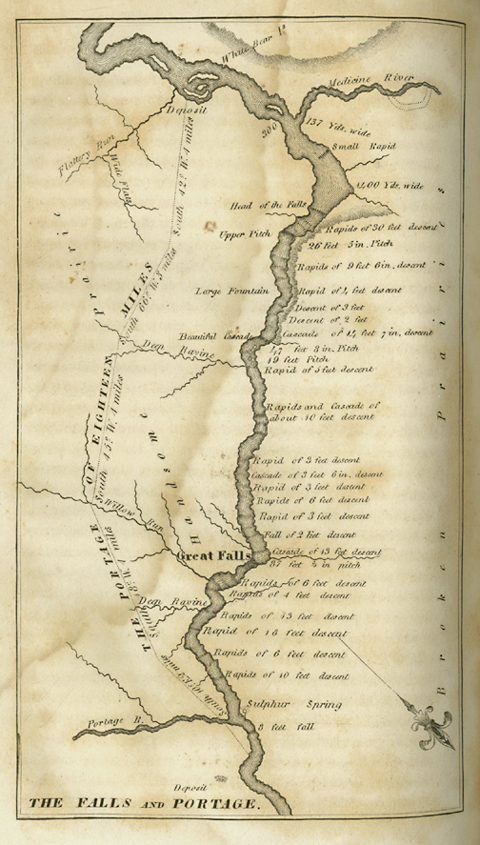
Clark’s Engraved Map
Clark’s map, engraved for the first edition of the journals
To see text and labels, point to the map.
Special Collections, Mansfield Library, The University of Montana, Missoula.[3]From Paul Allen, ed., History of the expedition under the command of Captains Lewis and Clark, to the sources of the Missouri, thence across the Rocky Mountains and down the river Columbia to the … Continue reading
Washington Dec. 8. 06.
Th: Jefferson presents his salutations to Dr. Wistar; & incloses him mr Stuart’s letter which gives the only information he possesses respecting the squirrel’s head. Capt. Lewis’s rout will probably, as soon as he arrives here be engraved. a copy shall be sent to the society, as also of Lt. Pike’s survey of the Misipi. & Freeman’s of the Red river.[4]Thomas Jefferson to Caspar Wistar, Founders Online, National Archives, founders.archives.gov/documents/Jefferson/99-01-02-4649 accessed 3 January 2026.
Notes
| ↑1 | Traveling with Meriwether Lewis to Washington City is a Mandan delegation from the Knife River Villages—Chief Sheheke, his wife Yellow Corn, and their son. Speaking Mandan and French was interpreter René Jusseaume who brought one of his wives and two children. Expedition private François Labiche was included to translate between French and English. Finally, records indicate expedition sergeant John Ordway was serving as Lewis’s assistant. During this time, William Clark remained at his home at the Falls of the Ohio. |
|---|---|
| ↑2 | “Alexander-Withrow House”, Virgina Department of Historic Resources (2 June 2023), www.dhr.virginia.gov/historic-registers/117-0001/; “Lexington Historic District”, National Register of Historic Places registration form (Rockbridge County, Virginia), www.dhr.virginia.gov/wp-content/uploads/2018/04/117-0027_Lexington_HD_2019-2023_NRHP_Update_FINAL.pdf. |
| ↑3 | From Paul Allen, ed., History of the expedition under the command of Captains Lewis and Clark, to the sources of the Missouri, thence across the Rocky Mountains and down the river Columbia to the Pacific Ocean. Performed during the years 1804-5-6. By order of the government of the United States. (2 vols., Philadelphia: Bradford and Inskeep, 1814), Plate 3. |
| ↑4 | Thomas Jefferson to Caspar Wistar, Founders Online, National Archives, founders.archives.gov/documents/Jefferson/99-01-02-4649 accessed 3 January 2026. |
Experience the Lewis and Clark Trail
The Lewis and Clark Trail Experience—our sister site at lewisandclark.travel—connects the world to people and places on the Lewis and Clark Trail.
Discover More
- The Lewis and Clark Expedition: Day by Day by Gary E. Moulton (University of Nebraska Press, 2018). The story in prose, 14 May 1804–23 September 1806.
- The Lewis and Clark Journals: An American Epic of Discovery (abridged) by Gary E. Moulton (University of Nebraska Press, 2003). Selected journal excerpts, 14 May 1804–23 September 1806.
- The Lewis and Clark Journals. by Gary E. Moulton (University of Nebraska Press, 1983–2001). The complete story in 13 volumes.
This site is provided as a public service by the
Lewis and Clark Trail Alliance
with additional funding from the following: