On or near this date, Lewis and the Mandan delegation pass through Fincastle, a notable junction on Virginia’s Great Wagon Road and a significant juncture in the life of co-captain William Clark.[1]Traveling with Meriwether Lewis to Washington City is a Mandan delegation from the Knife River Villages—Chief Sheheke, his wife Yellow Corn, and their son. Speaking Mandan and French was … Continue reading In January 1807, the “Citizens of Fincastle” would honor both captains in a written address to which Clark replied. On his way back to St. Louis in March 1807, he would propose marriage to Fincastle citizen Julia Hancock.
Clark’s Sketch of Fincastle (1810)
In Fincastle, Clark had been working with Nicholas Biddle and George Shannon to publish the first official edition of the expedition’s journals. In the following letter, he shares information with Benjamin Smith Barton regarding the journals and the town of Fincastle.
Louisville Kenty 22th May 1810
Dear Sir:
You will have seen Mr. N. Biddle who was with me some time at Fincastle and recved from him a Copy if such part of my journal as I had Copied from the Original, which I hope with the assistance of the specimins and what information the young gentleman who will hand you this letter (Mr. George Shannon)
Fincastle, Virginia c. 1845 (simulated)
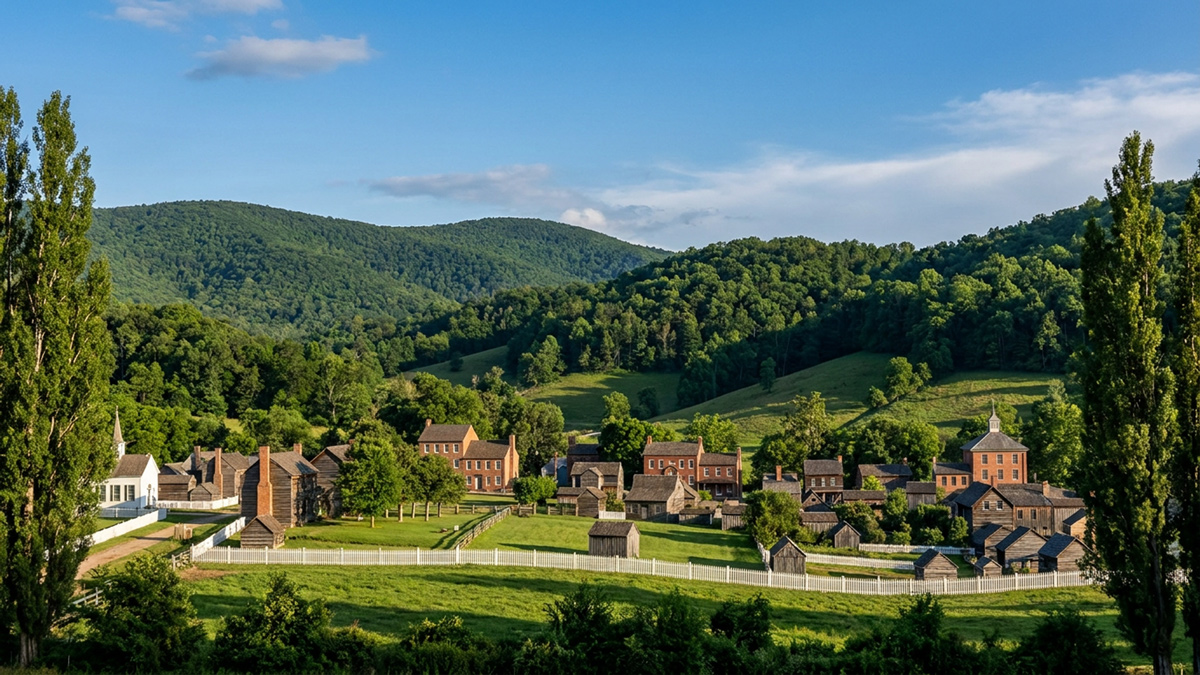
Generated from “Fincastle from Grove Hill”, an engraving Henry Howe’s Historical Collections of Virginia (1845), original available at commons.wikimedia.org/wiki/File:Historical_Collections_of_Virginia_-_Fincastle.jpg.

Clark continues his letter:
Inclosed is as much as I could Collect of the Origin and present state of Fincastle. As to population, it varies. I waited from the time I recved your letter untill I set out on my journey for a Clear View of the Peaks of Otter to make a Drawing for you, the weather being Cloudy &Smokey privented my having a few of any portion of the Mountain and have it in my Powor only to shew You by line the irregular appearance of the top of those Mountains about that place as they appear from Fincastle.
Wm. Clark[2]William Clark to Benjamin Smith Barton, in Letters of the Lewis and Clark Expedition with Related Documents: 1783–1854, ed. Donald Jackson (Urbana: University of Illinois Press, 1978), 2:548-49.
Clark may have tried to sketch the view of the mountains north of Fincastle as seen from Grove Hill. Both the simulated photograph shown above and the original 1845 sketch it is based on represent a romanticized view with artistic license applied.
Clark’s Intent to Propose Marriage (January 1807)
Washington City January 22nd 1807
Dear Brother
I arrived here on Sunday evening [18 January 1807] . . . .
I Shall leave [this] place in a Short time and possiably meet you, at any event wish to doe So. I Shall go the southern rout by Colo. Hancocks near Findcastle and the family of the Prestons. . . .
Wm. Clark
note
pleasee to tell Sister Clark that I have an object in view that I flatter my Self will extort from her that old promis, at all events it is almost time to put up the Chickens &ducks to fatten and prepare Sugar and plumbs for the pies.[3]James J. Holmberg, ed., Dear Brother: Letters of William Clark to Jonathan Clark (New Haven: Yale University Press, 2002), 119,122.
Apparently, William’s sister-in-law Sarah had promised a feast when he married and this was his way of announcing his proposal of marriage.
Setting the Date (March 1807)
[after 15 March 1807]
The post brought 3 letters to me from you dureing the time I delayed at near Fincastle . . . .
Frazier overtook me at Col. H. [Hancock] with a letter from you to me one to Mr. Batesm and a commission of B G [Brigadier General] of the Militia of Louisiana. . . . .
I have made an attacked most vigorously, we have come to terms, and a delivery is to be made first of January [. . .] when I shall be in possession highly pleasing to my self. I shall return at that time eagerly to be in possession of what I have never yet experienced. I hope my absence from the Louisiana will not be displeasing to the govermt.[4]Clark to Lewis in Jackson, Letters, 2:387–388.
The cryptic message in this letter makes sense if one already knows—as Lewis did—that Clark intended to propose to Julia Hancock in Fincastle. To Lewis, it was a clear announcement of the engagement with a wedding date set for January 1808. That Robert Frazer brought news of his promotion is almost lost within the letter.
Lewis came to Fincastle in November of the same year and was also smitten by a young lady from the Fincastle area. His attempts at a matrimonial arrangement did not fare as well. For more, see December 5, 1803.
From the Citizens of Fincastle (January 1807)
An address from the Citizens of Fincastle &its vicinity to Captains Meriwether Lewis &William Clarke — 8th of January 1807
Gentlemen
Sentiments of esteem and gratitude induce us to offer you our sincere congratulations, upon your safe return to the bosom of your country. During your absence upon a perilous &c laborious service, we have reflected with the deepest solicitude, on the dangers which you must necessarily encounter; our anxiety for your safety, and that of the party under your command, is now happily terminated. Your prudence, courage and good conduct have afforded us an oppertunety of yielding, without restraint to those emotions of Joy so natural to the mind, after having experienced a painful suspense. To those who have acted so distinguished &honorable a part on the theatre of human affairs, future life can not but afford the most soothing recollections. In whatever situation it may hereafter please the Supreme Being to place you, it will be a source of unmixed gratification to remember that in order to meet the just expectations, which your appointment by Government had excited, you have navigated bold &unknown rivers, traversed Mountains, which had never before been impressed with the footsteps of civilized man, and surmounted every obstacle, which climate, Nature, or ferocious Savages could throw in your way. You have the further satisfaction to reflect that, you have extended the knowledge of the Geography of your country; in other respects enriched Science; and opened to the United States a source of inexhaustible wealth, no event, which occurred during the expedition, can, in the smallest degree, impair the force of those solacing reflections. You have uniformly respected the rights humanity, actuated by principles of genuine philanthropy, you have not sprinkled your path with the blood of unoffending savages. Your fame will be as pure and unsullied, as of that great man to whom Europe is indebted for a knowledge of our continent; the extent and importance of which, it has been reserved for you to disclose to the world. We conceive it to be a signal proof of the wisdom and attention with which you have conducted the expedition, that but one man has been lost to your country. This fact will teach them that, discoveries (apparently the most difficult) may be effected without the effusion of human blood.
You will, Gentlemen, indulge us in declaring it as our opinion, that the rewards, which a grateful country may think proper to bestow, ought not to be apportioned to common merit or services, but that recompence to yourselves and to each individual under your command should be such as, in some measure, to atone for past perils, difficulties and privations With great respect we are Gentn. your humble Servts.
Pat Lockhart, Chairman
By order &on behalf of the Citizens
of Fincastle &c.
Lockhart’s address was delivered in the form of a letter. As was the practice, the paper was folded into an envelope and addressed: Captains Meriwether Lewis and William Clarke.[5]“Letter signed Pat Lockhart to Captains Meriwether Lewis and William Clark, January 8, 1807”, Missouri Historical Society, A0289-01347, mohistory.org/collections/item/A0289-01347, also in … Continue reading
To the Citizens of Fincastle
[after 8 January 1807]
Gentlemen,
Those sentiments of esteem and solicitude for our personal safty expressed in your affectionate address has excited in me the livelyest sencibility. To meet with the approbation of our country for the attempt which has been made to render services to the government by Capt. Lewis Myself and the party that accompanies us, is a source of the highest gratification. It will be pleaseing reflection in future life to find that the expedition has been productive of those advantages to our country, Geography, and science that you are willing to imagine. To respect the rights of humanity has and ever will be the leading principal of my life, and no reflection is more pleasing to me than that of effecting the objects we had in view with the effusion of so small a portion of human blood.
Gentlemen we ought to assign the general safty of the party to a singular interposition of providence, and not to the wisdom of those who commanded the expedition. Your anxiety that our country should reward our services with liberality, produces in me those immotions natural to the mind, at the same time acknowledging our uniform confidence not only in the justice but the liberality of our Country.
The friendly attention manifasted towards us by many of our fellow citizens is highly flattering, but the distinguished attention shewn to me by the Citizens of Fincastle &it’s vicinity produces those emmotions which I am unable to discribe, I will do my self the Honor to hand Capt. Lewis and make known to the faithfull party that accompanied, us, your friendly address, which i will undertake to say for them will be justly appreciated. You will please Gentlemen, except the best wishes of your most obedient Humble Servant,
Wm. Clark—[6]“Response of William Clark to address by the citizens of Fincastle”, Missouri Historical Society, A0289-01348, mohistory.org/collections/item/A0289-0134, also in Jackson, Letters, … Continue reading
Notes
| ↑1 | Traveling with Meriwether Lewis to Washington City is a Mandan delegation from the Knife River Villages—Chief Sheheke, his wife Yellow Corn, and their son. Speaking Mandan and French was interpreter René Jusseaume who brought one of his wives and two children. Expedition private François Labiche was included to translate between French and English. Finally, records indicate expedition sergeant John Ordway was serving as Lewis’s assistant. During this time, William Clark remained at his home at the Falls of the Ohio. |
|---|---|
| ↑2 | William Clark to Benjamin Smith Barton, in Letters of the Lewis and Clark Expedition with Related Documents: 1783–1854, ed. Donald Jackson (Urbana: University of Illinois Press, 1978), 2:548-49. |
| ↑3 | James J. Holmberg, ed., Dear Brother: Letters of William Clark to Jonathan Clark (New Haven: Yale University Press, 2002), 119,122. |
| ↑4 | Clark to Lewis in Jackson, Letters, 2:387–388. |
| ↑5 | “Letter signed Pat Lockhart to Captains Meriwether Lewis and William Clark, January 8, 1807”, Missouri Historical Society, A0289-01347, mohistory.org/collections/item/A0289-01347, also in Jackson, Letters, 1:358–59. This author has yet to find any primary sources that Lockhart’s address was delivered in person at a celebration in Fincastle. That story comes from Donald Culross Peattie, Forward the Nation (New York: G. P. Putnam’s Sons, New York, 1942), archive.org/details/forwardnation0000dona/. Peattie’s chapter contains many insertions of historical fiction such as saying both captains were present in Fincastle on 8 January, and that the pair then attended a ball where Clark was re-united with his future wife Julia Hancock. Peattie’s story was copied verbatim in R.D. Stoner, Seed-bed of the Republic (Roanoke, Virginia: Roanoke Historical Society), archive.org/details/seedbedofrepubli0000robe. Finally, in Gene Crotty, The Visits of Lewis & Clark to Fincastle, Virginia ([Roanoke, VA]: The History Museum and Historical Society of Western Virginia, 2003), p. 40, the story becomes ‘factual’ with Crotty citing Stoner as his source. |
| ↑6 | “Response of William Clark to address by the citizens of Fincastle”, Missouri Historical Society, A0289-01348, mohistory.org/collections/item/A0289-0134, also in Jackson, Letters, 359–360. |
Experience the Lewis and Clark Trail
The Lewis and Clark Trail Experience—our sister site at lewisandclark.travel—connects the world to people and places on the Lewis and Clark Trail.
Discover More
- The Lewis and Clark Expedition: Day by Day by Gary E. Moulton (University of Nebraska Press, 2018). The story in prose, 14 May 1804–23 September 1806.
- The Lewis and Clark Journals: An American Epic of Discovery (abridged) by Gary E. Moulton (University of Nebraska Press, 2003). Selected journal excerpts, 14 May 1804–23 September 1806.
- The Lewis and Clark Journals. by Gary E. Moulton (University of Nebraska Press, 1983–2001). The complete story in 13 volumes.
This site is provided as a public service by the
Lewis and Clark Trail Alliance
with additional funding from the following: