Sacagawea
Rendition by Carol Grende
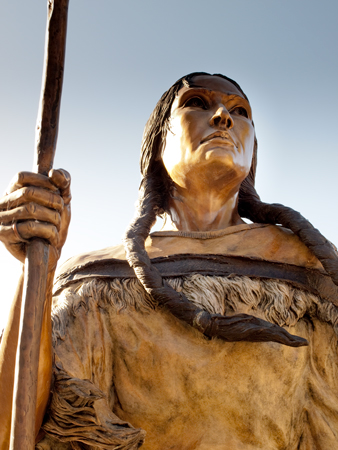
© 2009 by Kristopher K. Townsend. Permission to use granted under the Creative Commons Attribution-Share Alike 4.0 International license.
As with the majority of expedition members, Sacagawea’s likeness was not described or captured. For more artistic renditions, see on this site The Faces of Sacagawea.—Ed.
Three main accounts of Sacagawea’s pre- and post-Expedition life exist. The existence of three differing accounts demonstrates the way in which various groups seek to claim Sacagawea as their own. It also compels researchers and the public to conduct a thorough and careful analysis and interpretation of primary sources, oral histories, tribal identities, and family relationships in seeking to know Sacagawea for themselves.[1]This is an extract from Maren C. Burgess and Jay H. Buckley, “Seeking Sacagawea: A Comparison of the Principal Accounts of the Birth, Life, and Death of Bird Woman”, We Proceeded On 35, … Continue reading
The three accounts of Sacagawea’s birth, life, and death have ties to different Indigenous tribes, and each account is associated with a different rendition of her name.[2]For more names attributed to Sacagawea, see on this site Sacagawea’s Many Names. An analysis of the various spellings and meanings of Sacagawea is given in Irving W. Anderson and Blanche … Continue reading Her death in 1812 at Fort Manuel and burial near the Missouri River in present-day northern South Dakota is considered the most historically accurate by scholars who rely on contemporary written primary sources of the early nineteenth century.[3]William Clark made a list of the expedition members between 1825 and 1828 and recorded that Sacagawea was dead. “Clark’s List of Expedition Members,” Donald Jackson, ed., Letters of … Continue reading They support the Hidatsa derivation of her name “Sacagawea,” meaning “Bird Woman,” since she identified herself as such to Lewis and Clark. Many Lemhi and Eastern Shoshones prefer calling her “Sacajawea,” which means “Boat Launcher.”[4]Brigham D. Madsen, The Lemhi: Sacajawea’s People (Caldwell, ID: Caxton Printers, Ltd., 1990).
The Eastern Shoshone-Comanche account chronicles additional journeys and adventures Sacajawea supposedly had while living with Shoshone and Comanche groups in Wyoming, Colorado, and Oklahoma over many decades. Oral histories claim she died in 1884 and is buried in the Sacajawea Cemetery in Fort Washakie, Wind River Indian Reservation, in Wyoming.[5]Grace Raymond Hebard, Sacajawea: Guide and Interpreter of Lewis and Clark (1933; reprint, Mineola, NY: Dover, 2002), 90, 93, 288-89. Hebard was one of her first biographers. Other biographies … Continue reading
The Hidatsa-Crow account uses “Sacagawea” or “Sakakawea”, both meaning “Bird Woman”, or “Maeshuwea” meaning “Eagle Woman” as her name. Oral histories place her death in 1869 near the Upper Missouri River in Montana.[6]Sacagawea Project Board of the Mandan, Hidatsa & Arikara Nation, Our Story of Eagle Woman Sacagawea, 64.
Sacagawea’s Story
Interpreter with "fortitude and resolution"
by Barbara Fifer
She was with the expedition for just over 16 of the 28 months of the official journey. Speaking both Shoshone and Hidatsa, she served as a link in the communication chain during some crucial negotiations. She remains the third most famous person of the expedition.
Sacagawea In the Journals
by Kristopher K. Townsend
Sacagawea, also known as Sacajawea or Sakakawea, was a vital member of the Lewis and Clark Expedition, serving as an interpreter, diplomat, guide, and food gatherer. Her—and her child’s—presence symbolized peace among many of the Natives they encountered. The expedition journals document her life, tribal background, and key contributions.
The Hidatsa Story of Sakakawea
Alternate spelling, alternate story
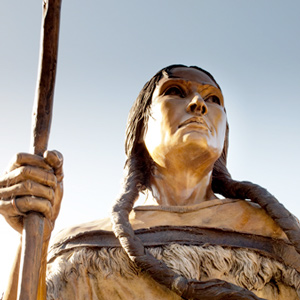
This story of Sakakawea (Sacagawea) as told by Bulls Eye to Major Welch circa 1924 provides an alternate version of her life before the expedition. To begin, he says that she was Hidatsa, not Shoshone….
Sacagawea’s Tribal Origin
Lemhi Shoshone or Hidatsa-Crow?
by Jay H. Buckley, Maren C. Burgess
A major discrepancy among the accounts of Sacagawea’s life is whether her tribal origin is Lemhi Shoshone or Hidatsa-Crow. Both accounts are explained.
Sacagawea’s Death
Three accounts
by Jay H. Buckley, Maren C. Burgess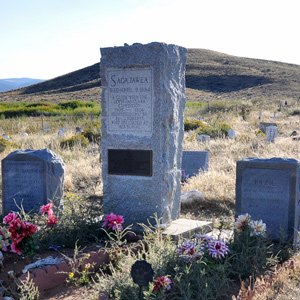
There are three accounts of how Sacagawea died as told by John Luttig and William Clark; Eastern Shoshones and Comanches; and the Hidatsas. All three accounts are explained.
The Faces of Sacagawea
Interpretations of an unknown image
by Joseph A. Mussulman
Because the Shoshone woman has been the subject of so many sculptures and paintings, especially since about 1900, we have a rich heritage of artists’ conceptions to contemplate.
Notes
| ↑1 | This is an extract from Maren C. Burgess and Jay H. Buckley, “Seeking Sacagawea: A Comparison of the Principal Accounts of the Birth, Life, and Death of Bird Woman”, We Proceeded On 35, no. 3 (August 2009), 8–19. We encourage the dedicated scholar to read the complete, original article at lewisandclark.org/wpo/pdf/vol49no3.pdf. |
|---|---|
| ↑2 | For more names attributed to Sacagawea, see on this site Sacagawea’s Many Names. An analysis of the various spellings and meanings of Sacagawea is given in Irving W. Anderson and Blanche Schroer, “Sacagawea, Sacajawea, or Sakakawea: How Do You Spell Birdwoman?” We Proceeded On 38:3 (August 2012): 10–11, lewisandclark.org/wpo/pdf/vol38no3.pdf. |
| ↑3 | William Clark made a list of the expedition members between 1825 and 1828 and recorded that Sacagawea was dead. “Clark’s List of Expedition Members,” Donald Jackson, ed., Letters of the Lewis and Clark Expedition with Related Documents, 1783-1854, 2nd ed. (Urbana: University of Illinois Press, 1978), 2:638-39; John C. Luttig, Journal of a Fur-trading Expedition on the Upper Missouri, 1812–1813, Stella M. Drumm, ed. (New York: Argosy-Antiquarian, 1964), 106; Larry E. Morris, The Fate of the Corps: What Became of the Lewis and Clark Explorers After the Expedition (New Haven: Yale University Press, 2004), 106-17, 210–13, 238–41. |
| ↑4 | Brigham D. Madsen, The Lemhi: Sacajawea’s People (Caldwell, ID: Caxton Printers, Ltd., 1990). |
| ↑5 | Grace Raymond Hebard, Sacajawea: Guide and Interpreter of Lewis and Clark (1933; reprint, Mineola, NY: Dover, 2002), 90, 93, 288-89. Hebard was one of her first biographers. Other biographies include: James Willard Schultz, Bird Woman (Sacajawea): The Guide of Lewis and Clark; Her Own Story Now First Given to the World (Boston: Houghton Mifflin, 1918); Harold P. Howard, Sacajawea (Norman: University of Oklahoma Press, 1971); Ella E. Clark and Margot Edmonds, Sacagawea of the Lewis and Clark Expedition (Los Angeles: University of California Press, 1979); and, most recently, Sacagawea Project Board of the Mandan, Hidatsa & Arikara Nation, Our Story of Eagle Woman Sacagawea: They Got It Wrong (Orange, CA: Paragon Agency, 2021). For an account of Sacagawea’s legendary role in American history, see Donna J. Kessler, The Making of Sacagawea: A Euro-American Legend (Tuscaloosa: University of Alabama Press, 1996). For a brief account, see Jay H. Buckley, “Sacagawea,” Encyclopedia Britannica, https://www.britannica.com/biography/Sacagawea, accessed May 11, 2023. |
| ↑6 | Sacagawea Project Board of the Mandan, Hidatsa & Arikara Nation, Our Story of Eagle Woman Sacagawea, 64. |
Experience the Lewis and Clark Trail
The Lewis and Clark Trail Experience—our sister site at lewisandclark.travel—connects the world to people and places on the Lewis and Clark Trail.

Discover More
- The Lewis and Clark Expedition: Day by Day by Gary E. Moulton (University of Nebraska Press, 2018). The story in prose, 14 May 1804–23 September 1806.
- The Lewis and Clark Journals: An American Epic of Discovery (abridged) by Gary E. Moulton (University of Nebraska Press, 2003). Selected journal excerpts, 14 May 1804–23 September 1806.
- The Lewis and Clark Journals. by Gary E. Moulton (University of Nebraska Press, 1983–2001). The complete story in 13 volumes.
This site is provided as a public service by the

Lewis and Clark Trail Alliance
with additional funding from the following: