In Washington City, news of the Louisiana Purchase is made public and President Jefferson issues Meriwether Lewis an open letter of credit. The city celebrates the fourth with an 18-gun salute, speeches, and a dinner followed by 17 toasts.
Louisiana Treaty Announced
Washington City—Official
National Intelligencer.
Washington City
Monday, July 4
Official.
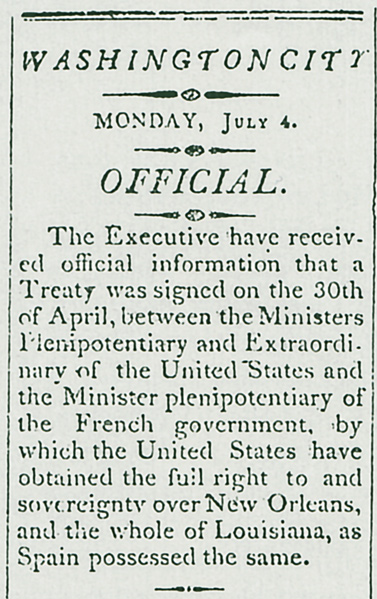
The Executive have received official information that a Treaty was signed on the 30th of April, between the ministers Plenipotentiary and Extraordinary of the United States and Minister plenipotentiary of the French government, by which the United States have obtained full right to and sovereignty over New Orleans, and the whole of Louisiana, as Spain possessed the same.[1]National Intelligencer (Washington, DC), 3 July 1803.
Jefferson’s Letter of Credit
Washington, U.S. of America.
July 4.1803.
Dear Sir
In the journey which you are about to undertake for the discovery of the course and source of the Missisipi, and of the most convenient water communication from thence to the Pacific ocean, your party being small, it is to be expected that you will encounter considerable dangers from the Indian inhabitants. should you escape those dangers and reach the Pacific ocean, you may find it imprudent to hazard a return the same way, and be forced to seek a passage round by sea, in such vessels as you may find on the Western coast.
[Y]our resource in that case can only be in the credit of the US. for which purpose I hereby authorise you to draw on the Secretaries of State, of the Treasury, of War & of the Navy of the US.
I Thomas Jefferson, President of the United States of America, have written this letter of general credit for you with my own hand, and signed it with my name.
TH: JEFFERSON[2]Thomas Jefferson to Meriwether Lewis, 4 July 1803, Founders Online, National Archives, founders.archives.gov/documents/Jefferson/01-40-02-0500 accessed 8 May 2022. [Original source: The Papers of … Continue reading
A Washington Fourth
July 5, 1803, Washington.
[Margaret Bayard Smith]
Yesterday was a day of joy to our citizens and of pride to our President. . . . The news of the cession of Louisiana only arrived about 8 o’clock of the night preceding, just in time to be officially announced on this auspicious day. . . . At an early hour the city was alive, — a discharge of 18 guns saluted the dawn, the military assembled exhibiting a martial appearance, at 11 o’clock an oration was held by Capt. Sprig . . . . at 12 company began to assemble at the President’s; it was more numerous than I have before marked it, enlivened too by the presence of between 40 and 50 ladies clothed in their best attire, cakes, punch, wine &c in profusion. After partaking of these mingled pleasures the company separated about 2, and at 3, the greater part assembled at Stille’s [Stelle’s] to the number of near 100.
Farewell
[Samuel Harrison Smith][3]Margaret Bayard Smith, The First Forty Years of Washington Society, Gaillard Hunt, ed. (New York: Charles Scribner’s Sons, 1906) 38–39.
Captain Sprigg’s Oration
Capt. Sprigg’s speech begins:
If man, in every age and country, has been taught to celebrate the annual return of domestic and national events, to welcome the advancing progress of his own life, or to unite in the commemoration of general calamity or of public joy; then, should this Day, which ushers in the twenty-eighth year of the Independence of America, be welcomed with grateful ardor by every child of virtuous liberty.[4]National Intelligencer, 11 July 1803, page 3. Also in The Independent American, 11 July 1803, page 2.
Seventeen Toasts
The fourth of July was celebrated at the Columbian Inn, Georgetown, (Pot.) by a large and respectable number of gentlemen, Citizens of Georgetown and the City of Washington, where after having partaken of an elegant dinner provided by Mr. Barney, the following TOASTS were drank,
- The DAY we celebrate—May its anniversary be always attended with a fresh infusion of the noble fire of ’76.
- The Federal Constitution, inviolate, the sure pledge of our liberty.
- The President of the United States.
- General George Washington—May a statue of reverence, respect and gratitude be fixed in the minds of every American citizen to his memory.
- The Heroes who fell in the American war—immortal bliss be their crown.
- The Constituted Authorities.
- Agriculture and Commerce.
- Laws without oppression, and liberty without licentiousness.
- The Union of all honest men.
- Party Spirit. A speedy dissolution to it by the true principles of republicanism in every one.
- The Army and navy of the U. States.
- The militia of the United States.
- The sovereignty of each state, a sure pledge for the liberty of all.
- Foreign nations—In peace with the U. S. good faith towards them.
- The District of Columbia—A good constitution and the right of suffrage.
- The state of Ohio—Our youngest sister—May she become one of the brightest gems in the Federal Confederation.
- The American Fair.
Entertaining songs, and the sparkling glass circulated briskly round during the day—and the celebration was concluded at an early hour in the evening, very much to the honor and satisfaction of all; under a discharge of Guns, from Captain K. Patterson’s Company of Artillery, and several vollies of small arms, from the Companies of Light Infantry and Grenadiers, commanded by Captains Sprigg and Patterson.[5]The Independent American, 11 July 1803, page 2.
Notes
| ↑1 | National Intelligencer (Washington, DC), 3 July 1803. |
|---|---|
| ↑2 | Thomas Jefferson to Meriwether Lewis, 4 July 1803, Founders Online, National Archives, founders.archives.gov/documents/Jefferson/01-40-02-0500 accessed 8 May 2022. [Original source: The Papers of Thomas Jefferson, vol. 40, 4 March–10 July 1803, ed. Barbara B. Oberg. Princeton: Princeton University Press, 2013, pp. 655–656.] |
| ↑3 | Margaret Bayard Smith, The First Forty Years of Washington Society, Gaillard Hunt, ed. (New York: Charles Scribner’s Sons, 1906) 38–39. |
| ↑4 | National Intelligencer, 11 July 1803, page 3. Also in The Independent American, 11 July 1803, page 2. |
| ↑5 | The Independent American, 11 July 1803, page 2. |
Experience the Lewis and Clark Trail
The Lewis and Clark Trail Experience—our sister site at lewisandclark.travel—connects the world to people and places on the Lewis and Clark Trail.
Discover More
- The Lewis and Clark Expedition: Day by Day by Gary E. Moulton (University of Nebraska Press, 2018). The story in prose, 14 May 1804–23 September 1806.
- The Lewis and Clark Journals: An American Epic of Discovery (abridged) by Gary E. Moulton (University of Nebraska Press, 2003). Selected journal excerpts, 14 May 1804–23 September 1806.
- The Lewis and Clark Journals. by Gary E. Moulton (University of Nebraska Press, 1983–2001). The complete story in 13 volumes.
This site is provided as a public service by the
Lewis and Clark Trail Alliance
with additional funding from the following: