Lewis and the Mandan delegates travel along Virginia’s Great Wagon Road bound for Washington City. On or near this day, they cross the New River on Ingles Ferry and proceed on to Christiansburg.[1]Traveling with Meriwether Lewis to Washington City is a Mandan delegation from the Knife River Villages—Chief Sheheke, his wife Yellow Corn, and their son. Speaking Mandan and French was … Continue reading
Crossing the New River
Although the Ingles family controlled both sides of the New River at the ferry site, the main base of their establishment was located on the Pulaski side. At the height of its operation, Ingles Ferry included the tavern (which also contained a store), stables and the ferry house. The earliest portion of the tavern was erected in 1772 with logs from an abandoned fort. Several additions were made, but the only remaining portions of the building are the early one-story log section and an early-nineteenth-century two-story frame wing. At present the remains of the tavern are unoccupied and are in a poor state of repair. The one-story ferry house which contained the winch used to propel the boats burned in 1967, and only its two chimneys remain. Across the river, on the Radford side, stands Ingleside, a two-story frame house erected by John Ingles in 1790. The house is in excellent condition and is owned by descendants of the Ingles family.
Ingles Ferry
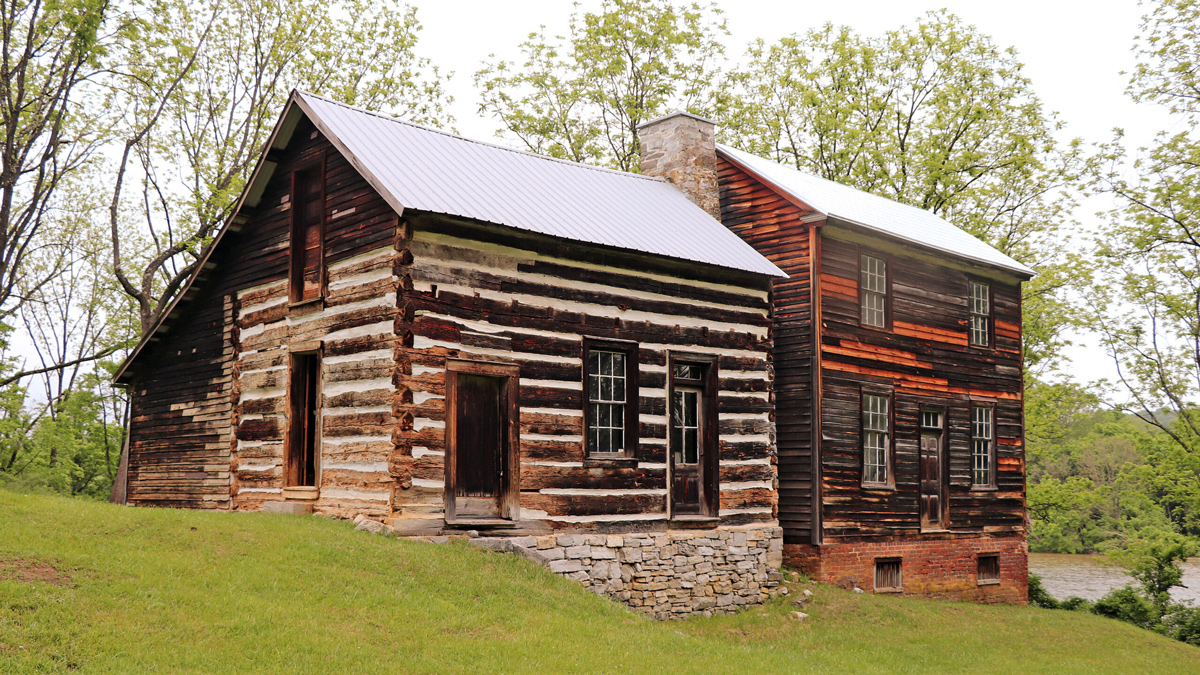
Brad McDonald, 2025, The Virginia Department of Historic Resources, www.dhr.virginia.gov/historic-registers/077-0013/.
Ingles Ferry was started by William Ingles in 1762 when he obtained a license to operate a ferry boat across the New River. Ingles was assisted in his enterprise by his brother-in-law, John Draper. The volume of commerce and travel increased rapidly, and the ferry became a prosperous business. The boat ran day and night, and the tolls amounted to over a thousand dollars a month. Over the ferry moved a major portion of the early settlers taking up land in Kentucky and Tennessee. The Ingles Ferry tavern, erected in 1772 on the Pulaski side of the river, became a popular social center with Andrew Jackson and George Rogers Clark among its more notable patrons. The bridge was burned in 1864 by retreating Confederate soldiers. The ferry boat was again put into service and continued to operate until 1948 when the last boat sank.[2]“Ingles Ferry”, National Register of Historic Places registration form (Pulaski County, Virginia), … Continue reading
Christiansburg
the name of Christiansburg first appears in records of the Virginia General Assembly on November 10, 1792. Most historians believe that the town was named for Colonel William Christian (1743─1786), an early settler in the New River Valley who became a Justice of Montgomery County in 1779 and was killed in a skirmish with Indians in Indiana in 1786.
The French prince Louis Phillippe visited Christiansburg on April 21, 1791, and wrote that it was “a tiny village of about ten houses.” This description seems to have been more or less accurate over the next decade. In 1793, five homeowners were licensed to operate ordinaries; much of their business likely came during the monthly court dates. Henry Edmundson’s tavern, for example, opened in 1807 and offered accommodations, breakfast and dinner, as well as recreation in the form of gin and toddies and dancing.[3]“Christiansburg Downtown Historic District”, National Register of Historic Places registration form (Montgomery County, Virginia), … Continue reading
Notes
| ↑1 | Traveling with Meriwether Lewis to Washington City is a Mandan delegation from the Knife River Villages—Chief Sheheke, his wife Yellow Corn, and their son. Speaking Mandan and French was interpreter René Jusseaume who brought one of his wives and two children. Expedition private François Labiche was included to translate between French and English. Finally, records indicate expedition sergeant John Ordway was serving as Lewis’s assistant. During this time, William Clark remained at his home at the Falls of the Ohio. |
|---|---|
| ↑2 | “Ingles Ferry”, National Register of Historic Places registration form (Pulaski County, Virginia), www.dhr.virginia.gov/VLR_to_transfer/PDFNoms/077-0013_Ingles_Ferry_Inn_1969_Final_Nomination.pdf. |
| ↑3 | “Christiansburg Downtown Historic District”, National Register of Historic Places registration form (Montgomery County, Virginia), www.dhr.virginia.gov/VLR_to_transfer/PDFNoms/154-5025_Christiansburg_Downtown_HD_2013_NR_FINAL.pdf. |
Experience the Lewis and Clark Trail
The Lewis and Clark Trail Experience—our sister site at lewisandclark.travel—connects the world to people and places on the Lewis and Clark Trail.
Discover More
- The Lewis and Clark Expedition: Day by Day by Gary E. Moulton (University of Nebraska Press, 2018). The story in prose, 14 May 1804–23 September 1806.
- The Lewis and Clark Journals: An American Epic of Discovery (abridged) by Gary E. Moulton (University of Nebraska Press, 2003). Selected journal excerpts, 14 May 1804–23 September 1806.
- The Lewis and Clark Journals. by Gary E. Moulton (University of Nebraska Press, 1983–2001). The complete story in 13 volumes.
This site is provided as a public service by the

Lewis and Clark Trail Alliance
with additional funding from the following: