Lewis is home for the holidays at the family farm ten miles west of Charlottesville, Virginia. Perhaps he recalls leaving home to pursue a military career. Meanwhile, Clark and likely York are on the Wilderness Road destined for Washington City.[1]Traveling with Meriwether Lewis to Washington City is a Mandan delegation from the Knife River Villages—Chief Sheheke, his wife Yellow Corn, and their son. Speaking Mandan and French was … Continue reading
Lewis’s Early Military Career
In preparation for the first official edition of the expedition journals, publisher Paul Allen asked Thomas Jefferson for biographical information about Meriwether Lewis:
Monticello. Aug. 18. 1813.
Sir
at the age of twenty, yielding to the ardor of youth, & a passion for more dazzling pursuits, he engaged as a volunteer in the body of militia which were called out by Genl Washington on occasion of the discontents produced by the Excise-taxes in the Western parts of the United States; and from that situation he was removed to the regular service as a lieutenant in the line. at twenty three he was promoted to a Captaincy; and, always attracting the first attention, where punctuality & fidelity were requisite, he was appointed paymaster to his regiment.
Th: Jefferson[2]“Thomas Jefferson to Paul Allen”, Founders Online, National Archives, founders.archives.gov/documents/Jefferson/03-06-02-0341-0002. [Original source: The Papers of Thomas Jefferson, … Continue reading
“…To Execute the Laws of the Union…”
by Donna Neary
Courtesy U.S. National Guard
Another document, endorsed by Thomas Jefferson but not written in his hand nor dated, offers further details of his military career:
In his twentieth year he joined a volunteer corps as a private under T. Walker against the insurgents. during the same year he was appointed Lieutenant in the US army. in his twenty third year he was promoted to a captaincy and returned to Albemarle to recruit [rest], he again joined the army and acted as paymaster untill he was made private secretary to the President[3]“Unidentified Author’s Short Biography of Meriwether Lewis”, Founders Online, National Archives, founders.archives.gov/documents/Jefferson/03-06-02-0341-0003. [Original source: The … Continue reading
The Whiskey Rebellion
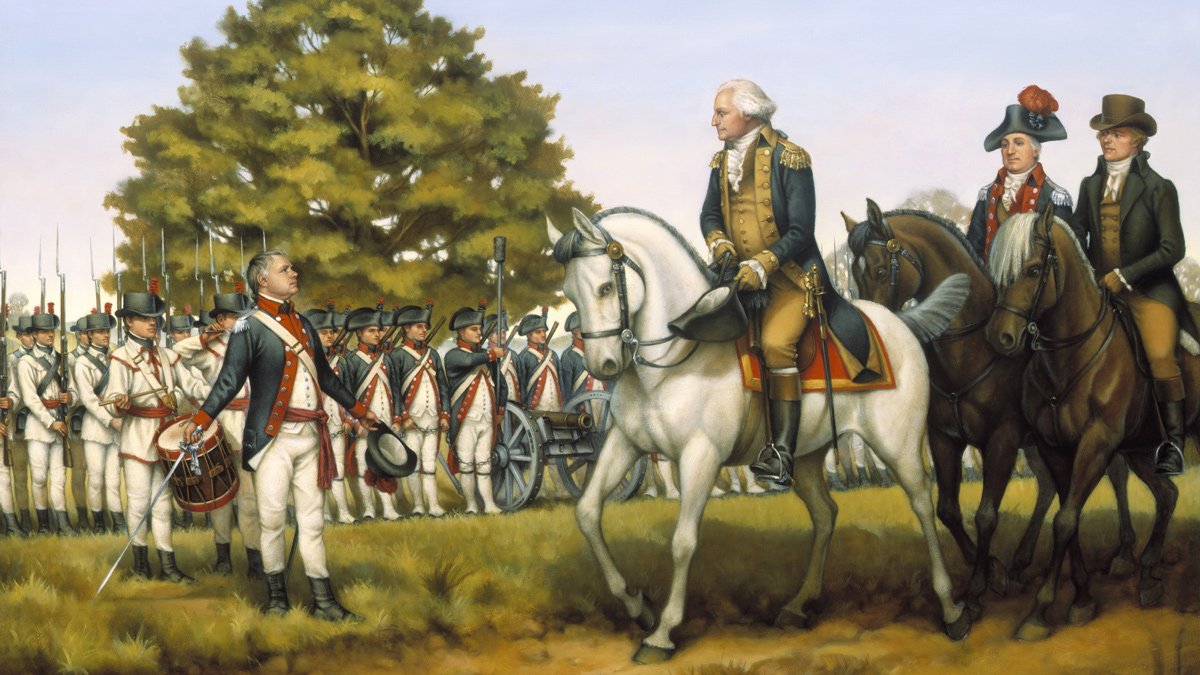
Accompanying the above figure, the U.S. National Guard provided the following description:
The Whiskey Rebellion. Harrisburg, Pennsylvania — October 3, 1794 — In September 1791 the western counties of Pennsylvania broke out in rebellion against a federal excise tax on the distillation of whiskey. After local and federal officials were attacked, President Washington and his advisors decided to send troops to pacify the region. It was further decided that militia troops, rather than regulars, would be sent. On August 14, 1792, under the provisions of the newly-enacted militia law, Secretary of War Henry Knox called upon the governors of Virginia, Maryland, New Jersey, and Pennsylvania for 12,950 troops as a test of the President’s power to enforce the law. Numerous problems, both political and logistical, had to be overcome and by October, 1794 the militiamen were on the march. The New Jersey units marched from Trenton to Harrisburg, Pennsylvania. There they were reviewed by their Commander-in-Chief, President George Washington, accompanied by Secretary of the Treasury and Revolutionary war veteran Alexander Hamilton. By the time the troops reached Pittsburgh, the rebellion had subsided, and western Pennsylvania was quickly pacified. This first use of the Militia Law of 1792 set a precedence for the use of the militia to “execute the laws of the union, (and) suppress insurrections”. New Jersey was the only state to immediately fulfill their levy of troops to the exact number required by the President. This proud tradition of service to state and nation is carried on today by the New Jersey Army and Air National Guard.[4]Provided by the U.S. National Guard, www.flickr.com/photos/thenationalguard/4101113956/.
Notes
| ↑1 | Traveling with Meriwether Lewis to Washington City is a Mandan delegation from the Knife River Villages—Chief Sheheke, his wife Yellow Corn, and their son. Speaking Mandan and French was interpreter René Jusseaume who brought one of his wives and two children. Expedition private François Labiche was included to translate between French and English. Finally, records indicate expedition sergeant John Ordway was serving as Lewis’s assistant. A large bill at Staunton, Virginia (see December 11, 1806) indicates that the delegation remained there while Lewis was at Locust Hill. |
|---|---|
| ↑2 | “Thomas Jefferson to Paul Allen”, Founders Online, National Archives, founders.archives.gov/documents/Jefferson/03-06-02-0341-0002. [Original source: The Papers of Thomas Jefferson, Retirement Series, vol. 6, 11 March to 27 November 1813, J. Jefferson Looney, ed. (Princeton: Princeton University Press, 2009), 418–426.] |
| ↑3 | “Unidentified Author’s Short Biography of Meriwether Lewis”, Founders Online, National Archives, founders.archives.gov/documents/Jefferson/03-06-02-0341-0003. [Original source: The Papers of Thomas Jefferson, Retirement Series, vol. 6, 11 March to 27 November 1813, J. Jefferson Looney, ed. (Princeton: Princeton University Press, 2009), 426.] |
| ↑4 | Provided by the U.S. National Guard, www.flickr.com/photos/thenationalguard/4101113956/. |
Experience the Lewis and Clark Trail
The Lewis and Clark Trail Experience—our sister site at lewisandclark.travel—connects the world to people and places on the Lewis and Clark Trail.
Discover More
- The Lewis and Clark Expedition: Day by Day by Gary E. Moulton (University of Nebraska Press, 2018). The story in prose, 14 May 1804–23 September 1806.
- The Lewis and Clark Journals: An American Epic of Discovery (abridged) by Gary E. Moulton (University of Nebraska Press, 2003). Selected journal excerpts, 14 May 1804–23 September 1806.
- The Lewis and Clark Journals. by Gary E. Moulton (University of Nebraska Press, 1983–2001). The complete story in 13 volumes.
This site is provided as a public service by the
Lewis and Clark Trail Alliance
with additional funding from the following: